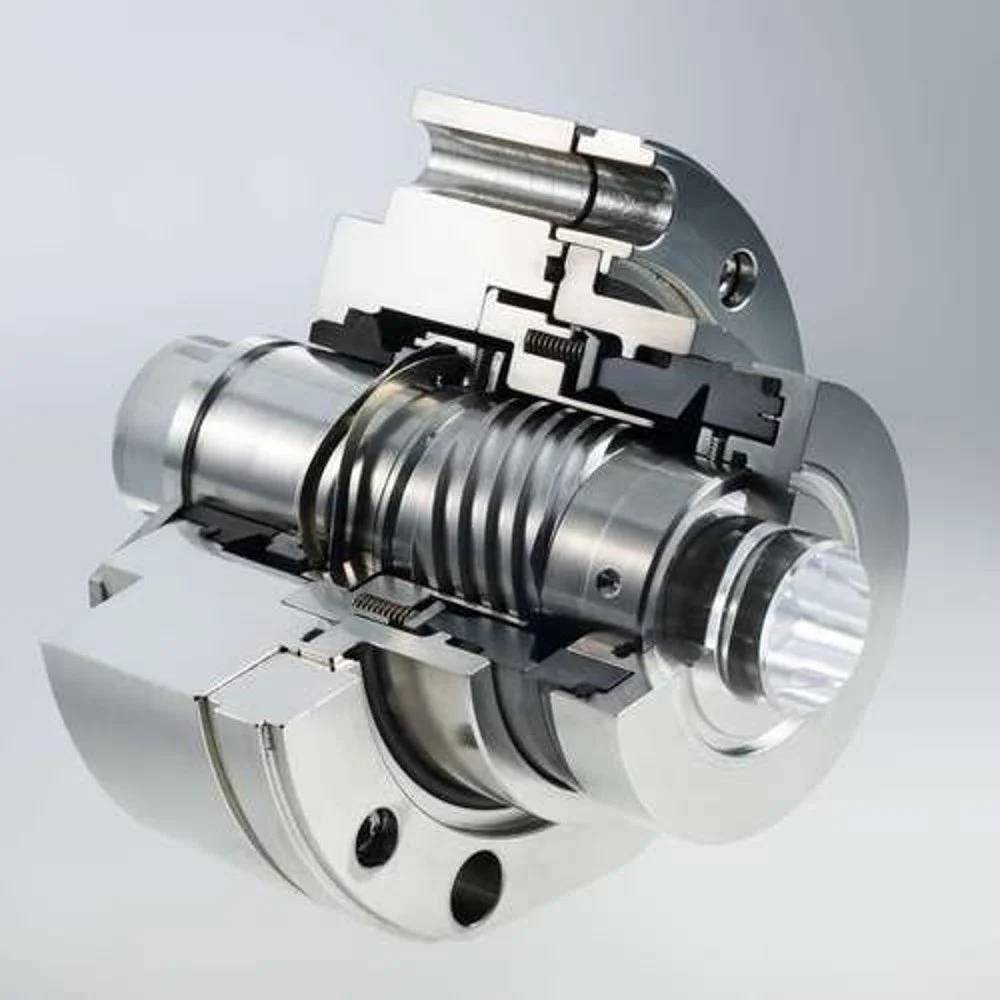
High-Containment Sealing

Double Mechanical Seals

Double Mechanical Seal ⚡ Dual Face Barrier

Technical Data

  • Faces: SSiC / TC / Carbon / Ceramic
  • Elastomers: Viton / Nitrile / EPDM / FFKM
  • Barrier System: API Plan 52 / 53A / 54
  • Pressure Limit: Up to 40 bar
  • Temp. Limits: -50°C to 280°C
  • Shaft Speed: Up to 25 m/s

Zero Process Emissions & Dry-Running Protection

Double mechanical seals consist of two primary sealing interfaces (inner/inboard and outer/outboard pairs) oriented back-to-back, face-to-face, or in tandem. The space between the inboard and outboard seal faces is filled with a clean buffer or barrier fluid (often supplied by an external reservoir under API Plan 52, 53A, or 54). By maintaining the barrier fluid at a higher pressure than the process media, any leakage across the inboard seal is pure barrier fluid—guaranteeing that zero process hazardous media escapes to the atmosphere.

Micro Engineering designs and manufactures premium double mechanical seals optimized for high-risk operations. These dual-face configurations isolate the atmosphere from dangerous, toxic, abrasive, or volatile organic compounds (VOCs). If the process fluid lacks lubricating qualities, or if the system runs dry, the barrier fluid continues to lubricate and cool the faces, preventing catastrophic seal failures and extending operational lifetimes.

Preferred choice for toxic chemicals, hazardous hydrocarbons, abrasive mineral slurries, polymerizing fluids, and thermal transfer fluids.

Features & Benefits

Dual-face technology offering absolute security for critical process lines.

Zero Process Leakage

By pressurizing the barrier fluid between the inboard and outboard seals, process fluid is completely blocked from escaping. It provides total containment for regulated or hazardous media.

Dry-Running Safety

If the pump experiences gas entrainment or suction loss, the external barrier fluid reservoir continues to lubricate and cool both seal faces, preventing face failure.

Media Isolation

Keeps abrasive solids, crystallizing liquids, or corrosive chemicals away from the outboard seal faces, dramatically extending overall seal service life in slurries.

API Plan Support

Fully compatible with standard API piping plans (Plan 52/53A/54) with integrated transmitters and switches for real-time monitoring of seal health.

Performance Boundaries & Setup

Comparing Double Mechanical Seals against Single Mechanical Seals.

Parameters Double Mechanical Seals Single Mechanical Seals
Sealing Boundary Two dynamic interfaces (inboard and outboard face pairs). One dynamic interface (single primary face pair).
Process Leakage Control Zero process leakage (blocked by barrier fluid system). Allows minor vapor escape (standard face lubrication film).
Auxiliary Support Requires API Plan reservoir, piping, and pressure dials. None required (operates directly in process fluid).
Clogging & Slurry Tolerance High (faces isolated from process slurries by clean barrier fluid). Moderate (springs/faces interact directly with process fluid).
Installation Footprint Requires larger axial and radial space on shaft. Compact; fits standard stuffing boxes easily.
Capital & Maintenance Cost High initial investment; dual face spares required. Very economical purchase price and simple rebuilds.

Typical Applications

High-reliability performance in severe-service or highly regulated operations.

01

Toxic & Volatile Chemicals

Sealing organic solvents, volatile hydrocarbons, carcinogenic chemicals, and acids where any atmospheric leakage is strictly prohibited.

02

High-Density Abrasive Slurries

Isolating seal faces in tailing slurries, lime loops, mining thickeners, and paper pulp stocks that would wear single seal faces instantly.

03

Agitators, Mixers & Reactors

Providing dynamic sealing on top-entry, side-entry, or bottom-entry industrial agitator shafts subject to high deflection and runout.

04

Thermal Oils & High Heat Fluids

Handling thermal fluids, boiler feeds, and heavy distillates where cooling buffer circulation is required to maintain seal stability.

Why Choose Our Double Seals?

Micro Engineering designs high-performance, double-face mechanical seals and auxiliary systems for critical, zero-tolerance industrial process loops.

Helium Flatness Verification

Faces are lapped to 1-2 light bands and verified under monochromatic light to guarantee immediate, leak-free commissioning.

API Plan Compatibility

Our designs are pre-engineered to connect seamlessly with API Plan 52 buffer and Plan 53A/54 barrier piping manifolds.

Premium Hard-Faced Metallurgy

Inboard faces are manufactured from high-purity silicon carbide or nickel-binder tungsten carbide to resist severe thermal shocks.

100% Pressure-Tested Assemblies

We perform dual-chamber hydrostatic and dynamic run pressure tests to verify seal integrity under maximum operating pressures.